


Quick Summary
Natural cleaning products usually contain plant-derived surfactants, bicarbonate of soda, white vinegar, citric acid, and essential oils or enzymes from citrus and other plants. Their focus is on ingredient origin and transparency rather than relying on strong chemicals to remove stains.
- Bicarbonate of soda suits gentle scouring and deodorising drains, as it is mildly alkaline.
- White vinegar suits removing limescale from taps and kettles, but can dull natural stone.
- Never combine vinegar or citric acid with chlorine bleach, as this releases toxic chlorine gas.
- Test any new cleaner on a small, inconspicuous area and wait 24 hours before using it widely.
- Homemade cleaners lack preservatives, so make small batches and use within two to four weeks.
How do you choose a natural cleaner?
Soapnut Republic HK offers natural cleaning products based on soapberries (soapnuts). With transparent ingredient lists, these products are ideal for households with children and pets.
Table of Contents
- What Ingredients Are in Natural Cleaners?
- Common Natural Ingredients and What They Clean
- Plant-Derived Surfactants and How They Work
- Natural Versus Conventional Cleaning Product Ingredients
- How to Read a Natural Cleaner Label and Verify Claims
- Ingredient Compatibility, Surface Safety and Mixing Risks
- Homemade Natural Cleaning Recipes and Their Limits
- Choosing a Natural Floor Cleaner and Soapnut Cleaning Solution
- Frequently Asked Questions
Natural Cleaning Product Ingredients: A Complete Guide
Last Updated: November 24, 2026
What Ingredients Are in Natural Cleaners?
Common Natural Ingredients and What They Clean
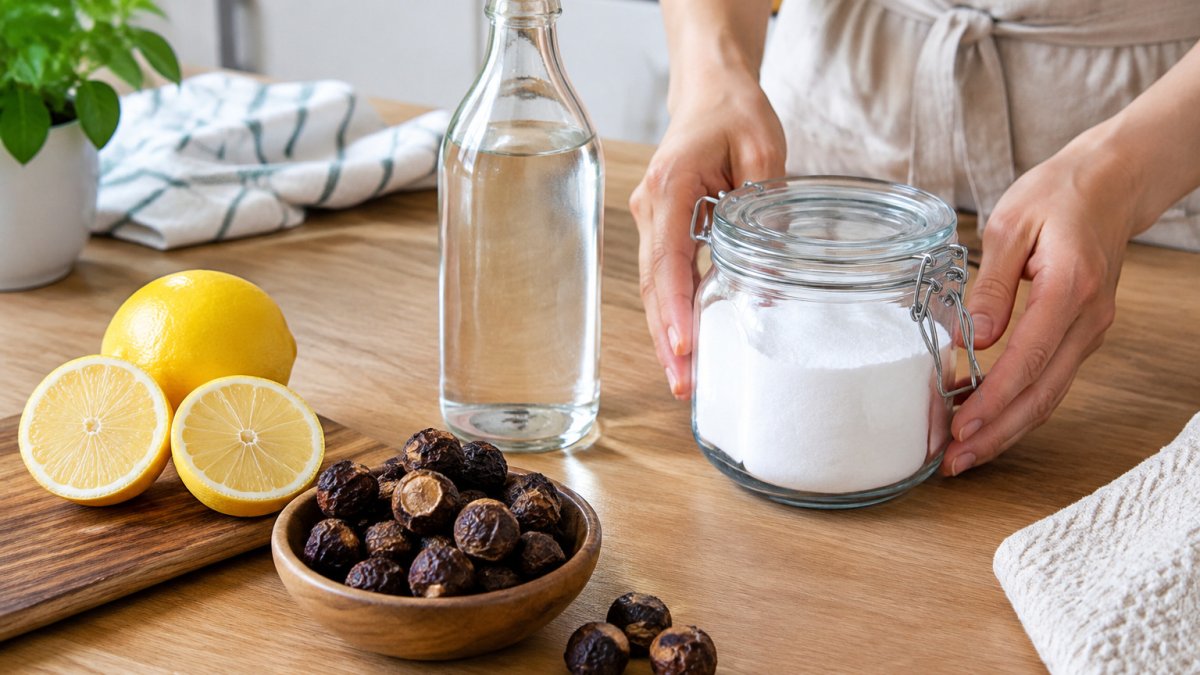
Bicarbonate of soda and white vinegar
University extension guidance on household cleaning agents generally distinguishes between mildly alkaline agents like bicarbonate of soda, which lift light grease and neutralise odours, and mildly acidic agents like white vinegar, which dissolve limescale and mineral deposits. The two behave differently, so they should not be treated as interchangeable.
- Bicarbonate of soda: Suits gentle scouring, deodorising drains and lifting light grime from sinks.
- White vinegar: Suits removing limescale from taps and kettles, but can dull natural stone and damage some grout over time.
Citrus oils, enzymes and plant extracts
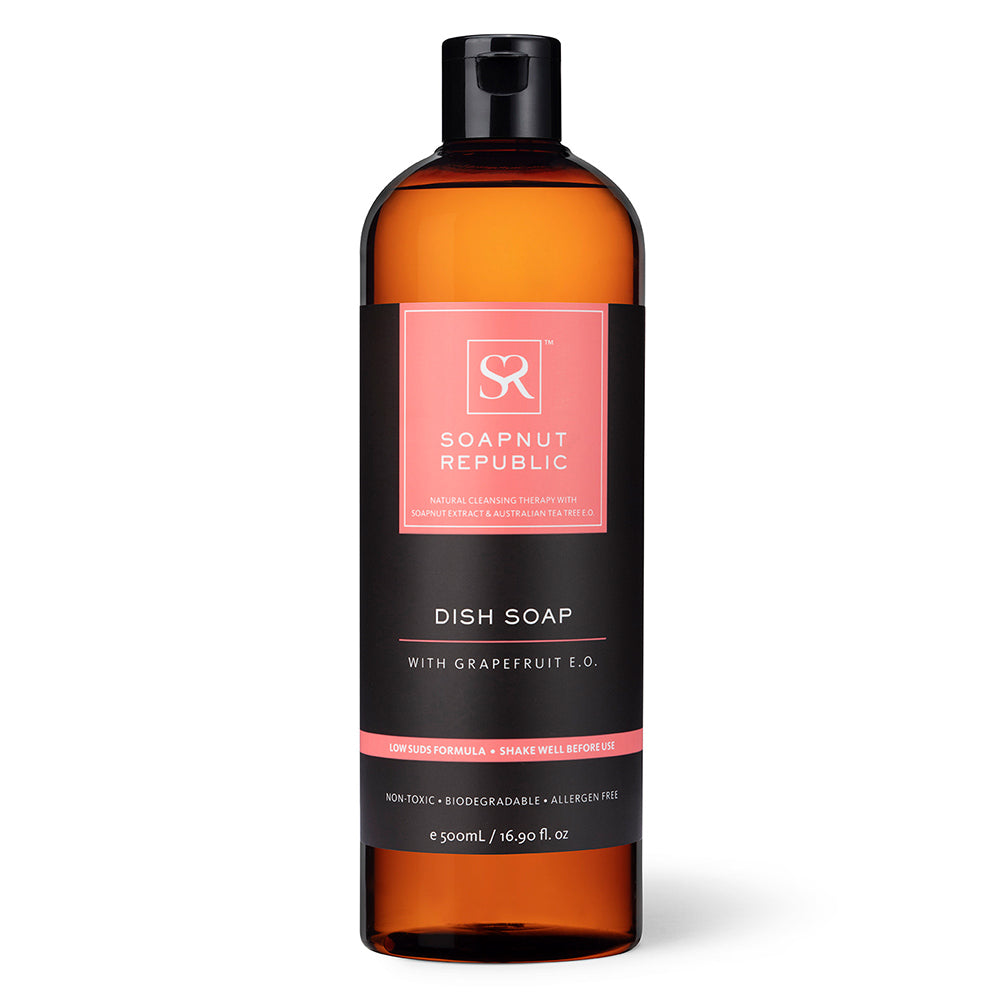
Citrus-derived oils such as those from orange or grapefruit peel are commonly used for their fresh scent and their ability to cut through light grease. Plant enzymes can help break down protein-based stains, though they work best in lukewarm water and need time to act. At Soapnut Republic HK, our Dish Soap uses grapefruit essential oil and is formulated to produce fewer suds, so less rinsing is required.
The table below summarises the main natural ingredients covered in this section and what each one suits.
| Ingredient | Best for | Key difference |
|---|---|---|
| Bicarbonate of soda | Gentle scouring, deodorising drains | Mildly alkaline; lifts light grease |
| White vinegar | Limescale on taps and kettles | Mildly acidic; dissolves mineral deposits |
| Citrus oils | Fresh scent, light grease | Cuts through light grease |
| Plant enzymes | Protein-based stains | Work best in lukewarm water, need time |
Plant-Derived Surfactants and How They Work
Surfactants are the molecules that make cleaning possible. Each has a hydrophobic end that grips oil and a hydrophilic end that attracts water, which lets grease lift off a surface and rinse away. Plant-derived surfactants, such as those extracted from soapnut berries, perform this same job using renewable botanical sources.
Natural Versus Conventional Cleaning Product Ingredients
The practical difference lies less in whether a product is "natural" and more in what it contains and how transparently it is labelled. Conventional cleaners often rely on synthetic surfactants, fragrances, and preservatives, which can be highly effective on tough soils but may irritate sensitive skin or airways.
consumer guidance on reading cleaning product labels notes that fragrance and preservative terms can hide multiple chemicals, which is why full ingredient disclosure matters when comparing products.
How to Read a Natural Cleaner Label and Verify Claims
Start by checking the ingredient list. In a well-formulated soapnut product, the soapnut berry extract should appear first, showing that it is the main active component. Scents should come from pure essential oils, not an undisclosed "fragrance" blend. To see how to spot genuine plant-derived ingredients and pH claims, read our label reading guide.
Next, look for specific claims rather than vague ones. "Biodegradable" should be backed by a recognised standard, and "non-toxic" is a marketing term without a fixed legal definition, so treat it with caution. Soapnut Republic HK publishes full ingredient lists for its products, so you can check the claims yourself before buying.
Ingredient Compatibility, Surface Safety and Mixing Risks
Natural ingredients are not automatically safe to combine or safe on every surface. Two practical rules prevent most problems: never mix cleaners unless you know exactly what is in each one, and always test on a hidden area first.
Mixing ingredients: what not to combine
Some combinations cancel each other out; others create genuine hazards.
- Bicarbonate of soda plus vinegar: This is the most common DIY mistake. Use them separately, one after the other, rather than together in the same bottle. If you use a natural cleaner on a greywater garden system, check whether natural cleaners are safe for greywater systems before routing the water into irrigation.
- Acids plus chlorine bleach: Never combine white vinegar, citric acid or any acidic cleaner with chlorine-based bleach. The reaction releases chlorine gas, which is toxic in a confined space such as a bathroom. The same risk applies to any product labelled as containing sodium hypochlorite.
- Hydrogen peroxide plus vinegar: Mixing these in the same container produces peracetic acid, which is corrosive. Keep them in separate bottles and use one at a time.
- Essential oils plus plastic: Concentrated citrus oils can degrade some plastics and rubber seals over time. Store oil-based mixes in glass where possible.
Watch out: even 'natural' ingredients can cause irritation. Vinegar and citric acid are mild skin irritants at higher concentrations, and essential oils such as eucalyptus and tea tree should never be applied undiluted.
Surface compatibility: what can be damaged
- Natural stone (marble, limestone, travertine): Acidic cleaners etch the surface permanently. Use a pH-neutral cleaner instead, and wipe up spills promptly.
- Grout and unsealed tile: Repeated vinegar use can erode grout over time. Rinse thoroughly after use and avoid leaving acidic solutions to sit.
- Wood and laminate: Excess water and acidic solutions can warp or dull finishes. Use a barely damp cloth and dry immediately.
- Aluminium and other soft metals: Acidic cleaners can pit or discolour these surfaces. Stainless steel is more tolerant but can still be affected by concentrated acids.
- Glossy plastics and acrylic: Abrasive powders such as bicarbonate of soda can scratch the surface. Use a soft cloth and a non-scratch sponge.
- Sealed surfaces: Always check the manufacturer's care instructions before introducing a new cleaner, as some sealants are sensitive to oils or acids.
A common pattern is to test any new cleaner on a small, inconspicuous area and wait 24 hours before using it more widely. This is especially important on stone, wood and metal.
Homemade Natural Cleaning Recipes and Their Limits
DIY cleaners work best when you treat them like any other product: measure accurately, store safely and replace them before they lose potency. The recipes below use common ingredients and include the details most summaries leave out.
All-purpose spray
- Recipe: Mix 1 part white vinegar with 1 part water in a clean spray bottle. A 1:1 ratio is a common starting point; for lighter cleaning, 1 part vinegar to 3 parts water is gentler.
- Use: Suitable for sealed worktops, sinks and bathroom fixtures. Not for natural stone, marble or unsealed grout.
- Storage and shelf life: Keep in a labelled spray bottle away from direct sunlight. Vinegar solutions lose strength over time; make small batches and use within two to four weeks.
Gentle scrub paste
- Recipe: Combine bicarbonate of soda with just enough water to form a thick paste. For extra cleaning power, add a small amount of castile soap.
- Use: Sinks, bathtubs and hobs. Avoid on glossy plastics, acrylic and polished stone, as the powder is mildly abrasive.
- Storage: Make only what you need for one cleaning session. The paste dries out and is best used fresh.
Glass cleaner
- Recipe: Mix 1 part white vinegar with 4 parts water in a spray bottle. Wipe with a microfibre cloth for a streak-free finish.
- Use: Windows, mirrors and glass surfaces. Avoid on tinted glass or surfaces with aftermarket films.
- Storage and shelf life: Use within two to four weeks; label the bottle clearly.
Drain refresher
- Recipe: Pour half a cup of bicarbonate of soda down the drain, follow with a cup of hot water after 15 minutes. For a stronger effect, follow with a cup of white vinegar and let it fizz for 10 minutes before flushing with hot water.
- Use: Maintenance for slow drains, not a substitute for clearing a serious blockage.
- Storage: Use immediately; there is nothing to store.
Realistic limits
Homemade cleaners are not tested for consistent strength, so they may underperform on heavy grease, baked-on food or stubborn stains. Vinegar solutions lose potency over time, and DIY mixes lack preservatives, which is why small batches and short shelf lives matter. For heavy soiling or tasks that require a consistent result, a purpose-formulated product is usually more reliable.
Watch out: never store homemade cleaners in unlabelled containers, and keep all mixes out of reach of children and pets.
Choosing a Natural Floor Cleaner and Soapnut Cleaning Solution
For households with cats or dogs, check that a floor cleaner lists its essential oils clearly, since some oils can be harmful to pets even when the product is natural. Our guide to natural cleaners for pet households covers which ingredients to avoid and what to do if a pet swallows a cleaner. veterinary guidance on essential oil toxicity in pets advises caution with concentrated oils around animals.
If you are looking for a floor cleaner with clearly listed ingredients, our Floor Cleaner - Eucalyptus Essential Oil is infused with eucalyptus essential oil and is available in 1L and 5L sizes. For a broader range of surfaces, the Multi Purpose Cleaner - Citrus Essential Oil (5L) is designed to clean and deodorise hard household surfaces such as bathrooms, kitchen bench tops and appliances.
Ready to switch? Explore the Soapnut Republic HK range and find a natural cleaner with a full, transparent ingredient list for your home.
Frequently Asked Questions
What ingredients are commonly found in natural cleaning products?
Natural cleaning products usually combine plant-derived surfactants, such as those from soapnut berries, with mineral and acidic ingredients like bicarbonate of soda, white vinegar and citric acid. Citrus oils and plant extracts are often added for scent and mild cleaning action. A well-formulated product lists its main ingredient first, so check the label order before buying. Soapnut Republic products list soapnut berry extract as the first ingredient, with essential oils providing the only scent.
Are natural cleaning products safer for people and pets?
Natural products generally avoid some of the harsher synthetic ingredients found in conventional cleaners, but natural does not automatically mean harmless. Essential oils can irritate sensitive airways or skin, and some pets react to strong scents. Look for simple ingredient lists, avoid products with unnecessary fragrance, and ventilate the room after cleaning. Soapnut Republic HK products are completely free from hormone disrupters and cancer-causing agents.
What chemical ingredients are commonly found in conventional cleaning products?
Conventional cleaners often contain synthetic surfactants, fragrances, phosphates, ammonia and bleaching agents. These ingredients can be effective on grease and stains but may leave residues or irritate people with allergies, eczema or respiratory conditions. Comparing the full ingredient list of a conventional product with a natural one is the simplest way to see the difference in practice.
How can you make a soapnut cleaning solution at home?
A basic soapnut solution is made by simmering dried soapnut shells in water for around 20 to 30 minutes, then straining the liquid and storing it in a clean bottle. Homemade solutions have a short shelf life, usually a few days to a week in the fridge, and they do not contain the stabilisers or tested formulation of a commercial product.
Can natural cleaning ingredients damage floors or other surfaces?
Yes. Acidic ingredients such as vinegar and citric acid can etch natural stone like marble and dull some sealed timber, while concentrated essential oils can soften certain plastics. Test any new cleaner or recipe on a hidden patch first, and dilute acidic mixtures. The Soapnut Republic Floor Cleaner with eucalyptus essential oil eliminates dirt, grime and germs from floors and leaves a streak-free finish, but you should still check your flooring material before first use.
What should you check on a natural cleaning product label?
Start with the ingredient order, since the first ingredient is present in the highest amount. Check whether the scent comes from named essential oils or from an undisclosed fragrance, and look for a full ingredient list rather than vague wording like plant-based blend. Be cautious of claims such as biodegradable without supporting detail. Soapnut Republic HK publishes full ingredient lists for its products, so you can check what is inside.


